Huize Beatrix on Aagje Dekenlaan
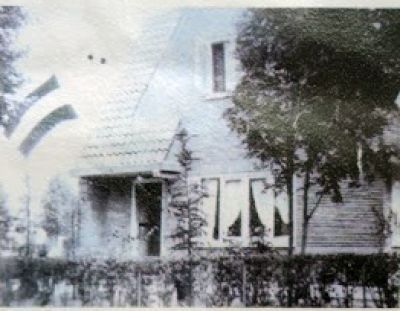
Huize Beatrix on Aagje Dekenlaan
(during World War II still called Hartmanlaan) [1]
by René van Hal
This contribution forms part of the article in the thematic issue published in 2025 by the Historical Society Soest/Soesterberg entitled “80 Years of Liberation.”
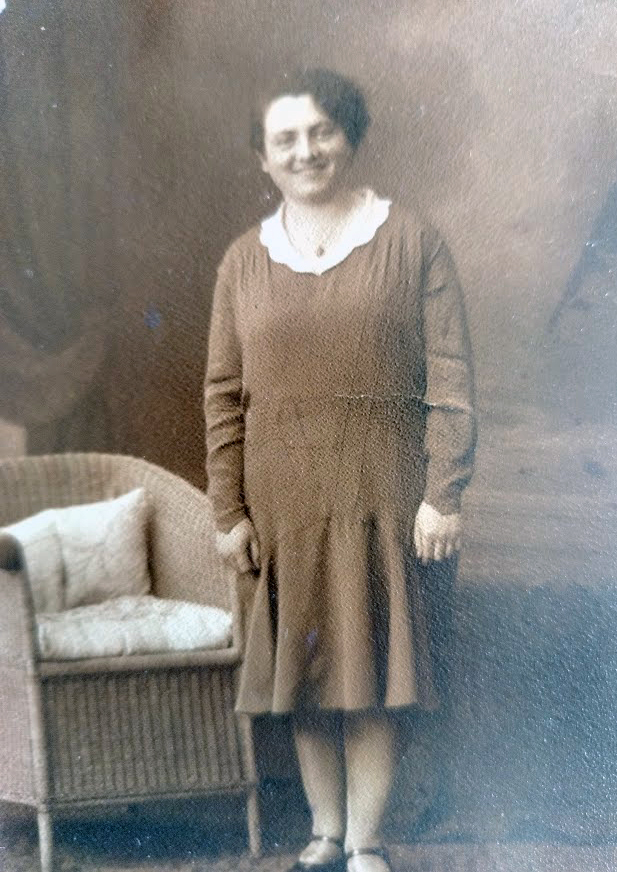 Alice Wolf (www.oorlogsbronnen)
Huize Beatrix [2] tells the story of the Jewish woman Alice Wolf and her son Herbert. Alice was born on 7 November 1909 in Essen-Katernberg. She was the second daughter of Moritz Wolf and Jeanette Schwarz. She had one older sister, Thea. After completing secondary school (Mittelschule), she began training as a nurse, but after one year she was forced to discontinue her studies due to illness. She then trained as a dressmaker and entered into a relationship with a non-Jewish man. Marriage was not possible under the laws in force at the time: Jews were forbidden to marry non-Jews as a result of the Nuremberg Race Laws of 1935. [3]
At the end of 1936, however, she became pregnant and decided to go to the Netherlands, to Amsterdam. There, her son Herbert was born on 1 July 1937. In January 1938, she moved with her son to Braamweg in Soest and found employment as a domestic servant with a lady-in-waiting to Princess Juliana and Queen Wilhelmina, who was also involved in the care of Princess Beatrix. Through these ladies-in-waiting, Alice was given the use of a house on Hartmanlaan so that—where her heart truly lay—she could take in Jewish children.
In total, she took in seven Jewish children, who were also registered in the civil registry of Soest. In addition, she took in her nephew Klaus [5]. He was not registered in Soest, as it was assumed that his mother would soon come to collect him in order to continue on to France, where his father had already fled. During the period in which Alice lived on Hartmanlaan, she therefore cared for eight Jewish children. Most of them were taken in only for short periods. Alice Wolf ran this children’s home from January 1938 until February 1940. [6]
The house was given the name of Huize Beatrix, a reference to Princess Beatrix, who was born in 1938 at Soestdijk Palace, and to the relationship that existed with the residents and staff of the palace.
Tensions in the world increased and by 1939 there was already serious concern that Germany would invade the Netherlands. The royal couple prepared for this possibility and made plans for their escape in the event of a German invasion. These preparations included a reduction in staff at Soestdijk Palace. As a result, Alice lost her job as a domestic servant to the aforementioned lady-in-waiting in January 1940 and consequently no longer had access to the house on Hartmanlaan.
Forced by circumstances, the children’s home was closed and in February 1940 Alice returned to Amsterdam. Most of the children, still in her care at that time, were placed in the Janna Children’s Home at Middenweg 132 in Amsterdam, an institution for children of unmarried mothers. Because her nephew Klaus could not be placed there—his parents were married and had plans to leave Germany but had not yet done so—Alice accommodated him with another Jewish family. This proved to be his salvation, as he survived the war. [7]
This was not the case for Alice and her son Herbert. Along with other children from the Janna Children’s Home they were transferred to Westerbork in the spring of 1942, where they were registered on 15 July 1942 and immediately deported to Auschwitz. Herbert was murdered on 17 July 1942 at the age of five. According to the Auschwitz records, his mother Alice was murdered on 30 September 1942 at the age of thirty-two. However, it is highly likely that, like the other people on the transport of 15 July 1942 [8], she was murdered immediately upon arrival in Auschwitz. [9]
Little information about Huize Beatrix is to be found in the archives. Thanks in part to the efforts of Alice Wolf’s sister, Thea Levinsohn-Wolf, and the Rosenthal family, some information was eventually uncovered.
The family shared this information with, among others, the Historical Society Soest/Soesterberg and the archives of the Municipality of Soest. In this way, a fragment of the history of Jewish children from that period can be preserved and the memory kept alive. At present only for some of the eight children is it known how their lives developed after leaving Soest. For three of the children, it is completely unknown where they went after their stay in Soest.
Notes
[1] This house was built in 1936 by mason-contractor Cornelis van den Broek, who rented it out before selling it in 1942.
[2] https://www.joodsmonument.nl/nl/page/753530/huize-beatrix-soest
[3] https://historiek.net/neurenberger-rassenwetten-1935/2314/
[4] According to unconfirmed information, the financing of this house was arranged through the royal family, specifically by the royal couple.
[5] His surname is known to the author. At the request of the Witbraad family, it is not disclosed.
[6] https://www.joodsmonument.nl/nl/page/752733/
[7] Klaus’s mother never had the opportunity to collect him. She was arrested in Germany and did not survive the war. His father and a brother were also betrayed and did not survive. The family was therefore never reunited.
[8] A total of no fewer than 1,137 Jews was deported to Auschwitz in this transport.
[9] https://www.joodsmonument.nl/nl/page/168418/click.to.mail
Sources
- Information from family members of Alice Wolf based on research conducted by them
- Background information on the history of Huize Beatrix, Aagje Dekenlaan (during World War II Hartmanlaan) by Arjan Geers, archival staff member of the Municipality of Soest
Additional Background Information
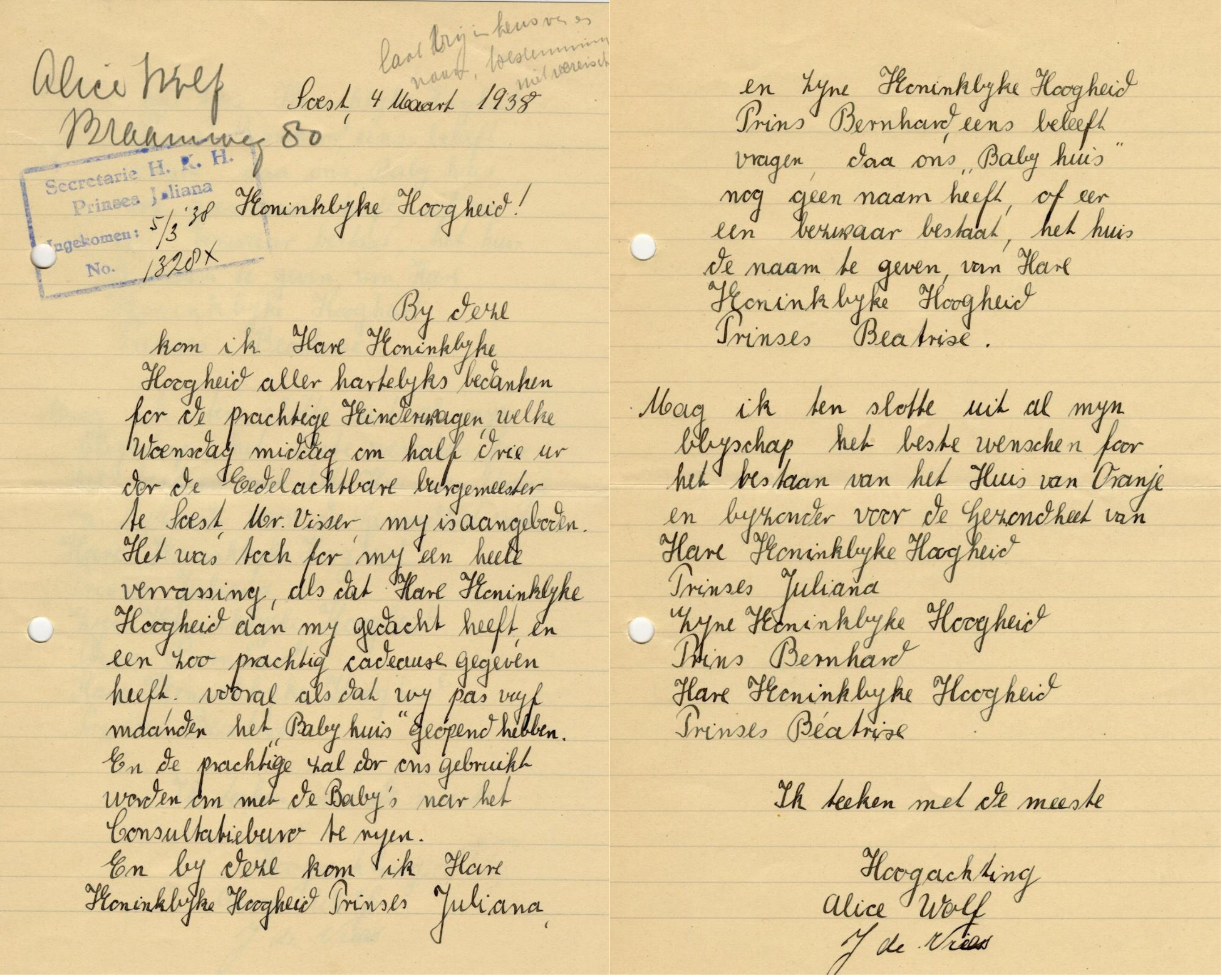
- On 4 March 1938, Alice Wolf submitted a request to Princess Juliana asking permission for her children’s home to bear the name of Huize Beatrix. A copy of this letter, made available by the Royal Archives, confirms that Princess Juliana gave her approval. The children’s home for Jewish refugees was thus given the name of Huize Beatrix.
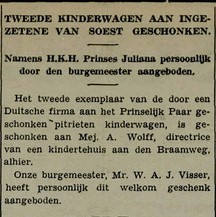
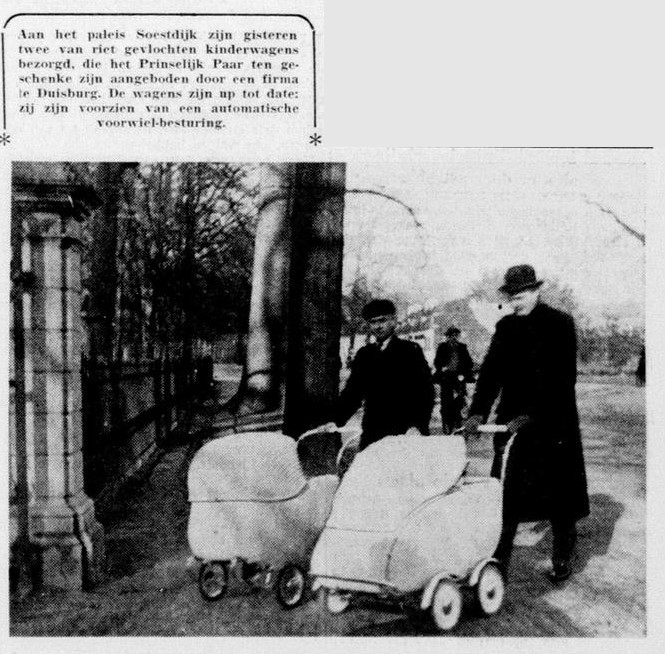
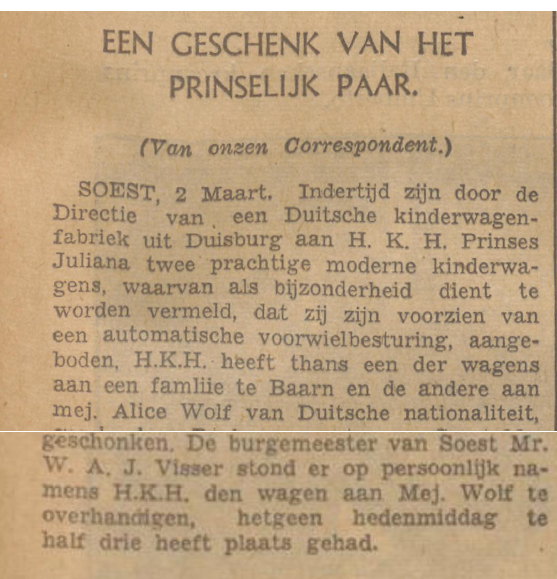
- A report in De Soester dated 5 May 1938 describes how the mayor of Soest, Mr. W. Visser, on behalf of Princess Juliana, presented a baby carriage to Alice Wolf’s children’s home. At that time, the home was still located on Braamweg. A few months later, A. Wolf and the children moved to Hartmanlaan (now Aagje Dekenlaan). The baby carriage was one of two donated by a firm in Duisburg (see De Telegraaf, 9 February 1938). Several national newspapers (such as the Christelijk Sociaal Dagblad voor Nederland, 2 March 1938) also reported on Princess Juliana’s donation of the baby carriage to A. Wolf.
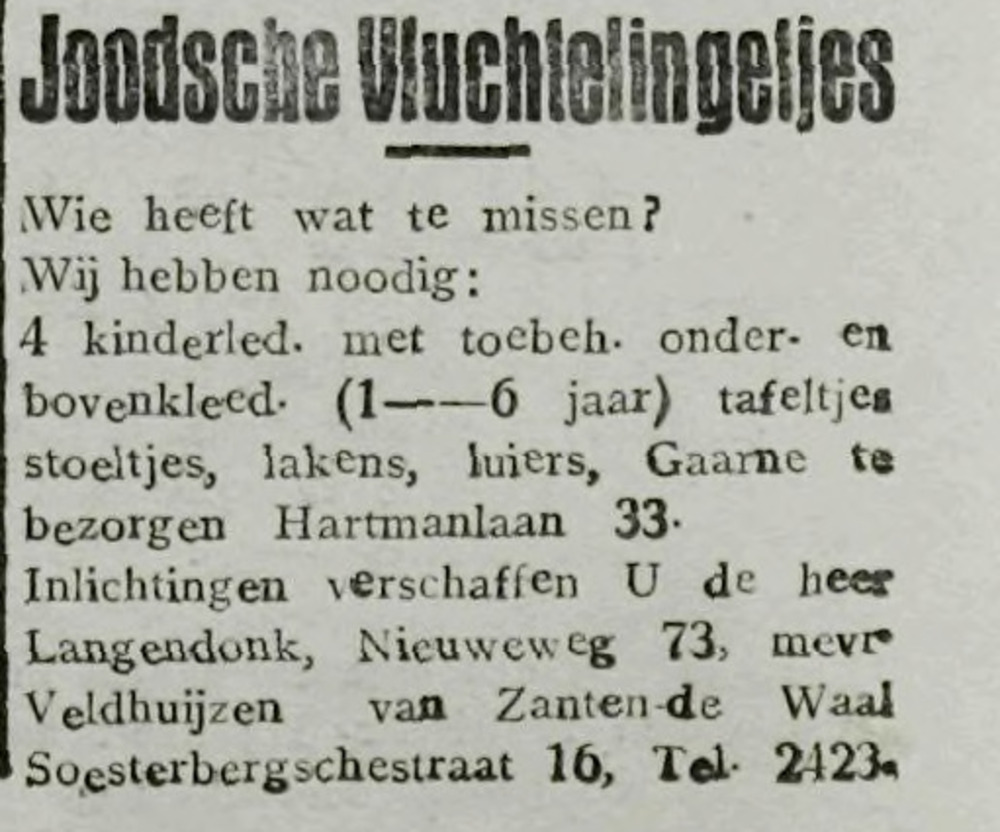
- A newspaper article in De Soester dated 30 June 1938 called for donations of goods for Jewish refugee children. At that time Alice Wolf was already living on Hartmanlaan.
- A photograph exists of the baby carriage donated by Princess Juliana, containing several of the children taken in at Huize Beatrix.
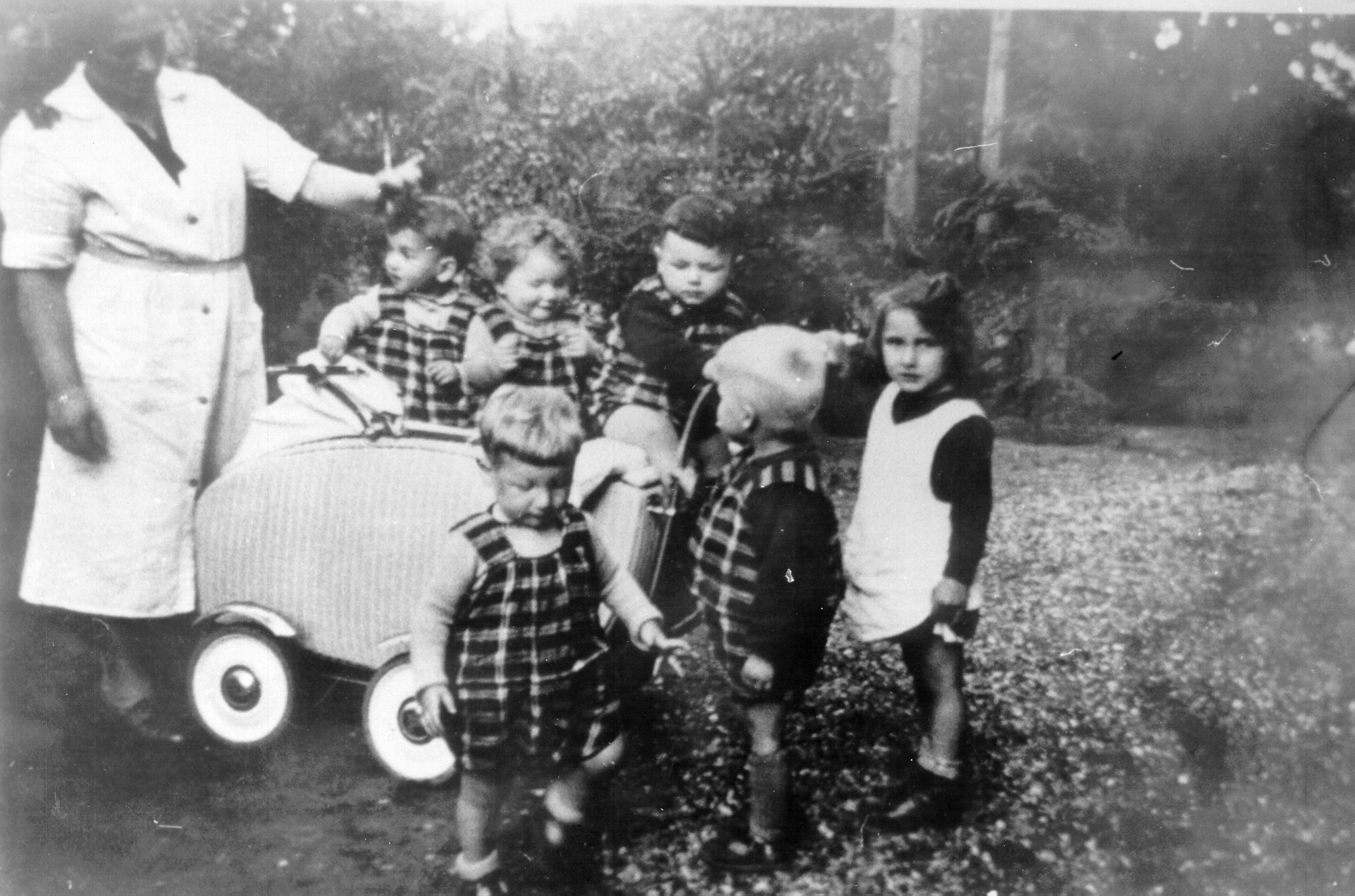
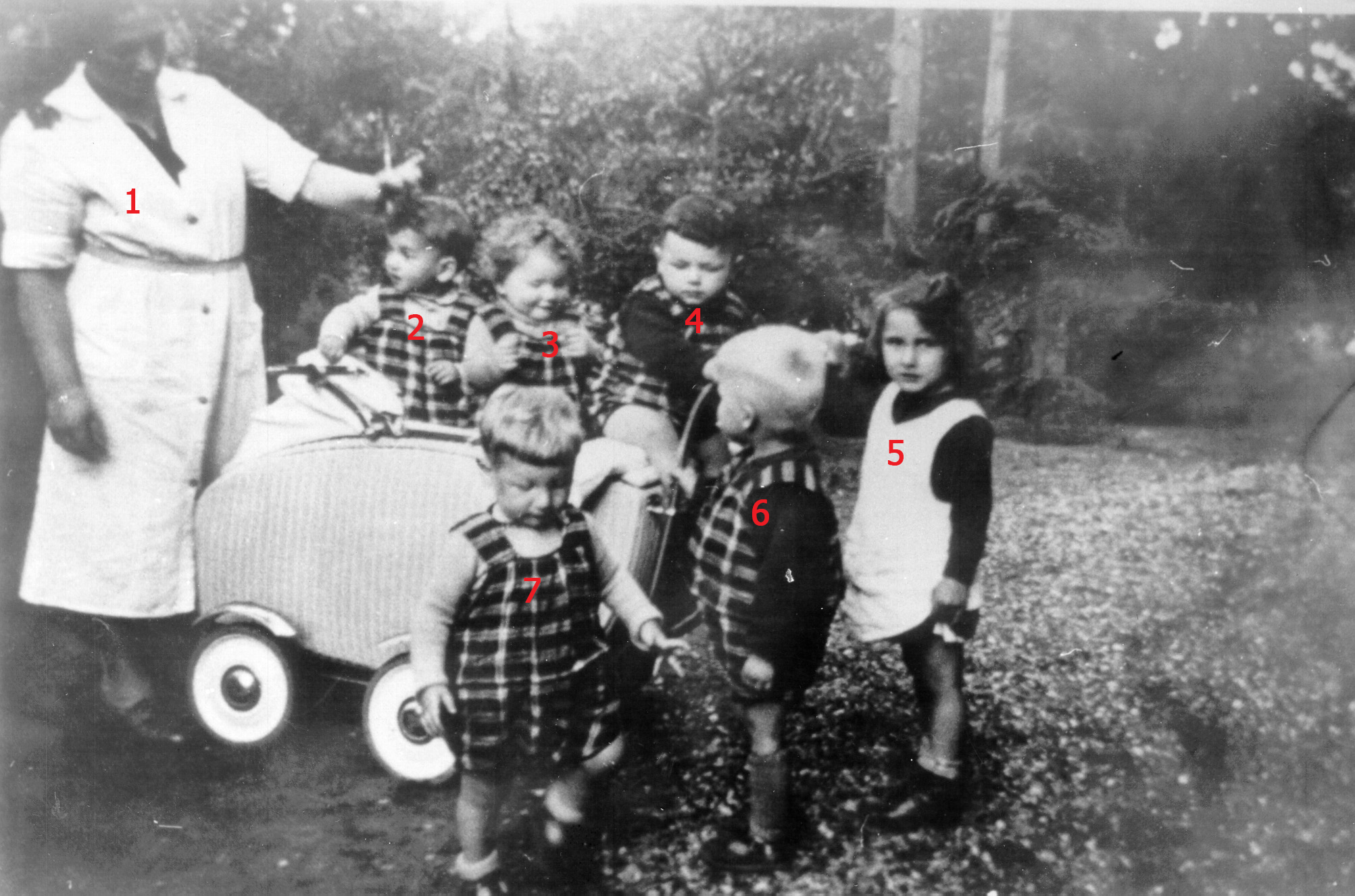
In the photograph are Alice Wolf (no. 1), Herbert Wolf (4), and Antje Heimberg (5). The identities of three of the children in the photograph remain unknown.
- A photograph also exists of Alice Wolf’s son Herbert (1937–1942), standing on a low wall near Huize Beatrix.
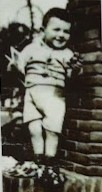
- Klaus Rosenthal survived the Second World War, married after the war, and had three daughters. In 1996, 51 years after the end of World War II, his daughters met Alice’s sister Thea Wolf and two other great-aunts in Germany for the first time. Until then the Wolf family had not known that Klaus had survived the war. Thea, Alice’s sister, died in 2005 at the age of 95.
- Since 1945 Thea Wolf attempted unsuccessfully to trace the names and nationalities of the children who had been sheltered at Huize Beatrix. The Rosenthal family later continued this search. Not all names have yet been identified. Only in 2024 the location of Huize Beatrix was definitively established.
- In October 1990 Thea Levinsohn-Wolf wrote a commemorative text, which is reproduced elsewhere.
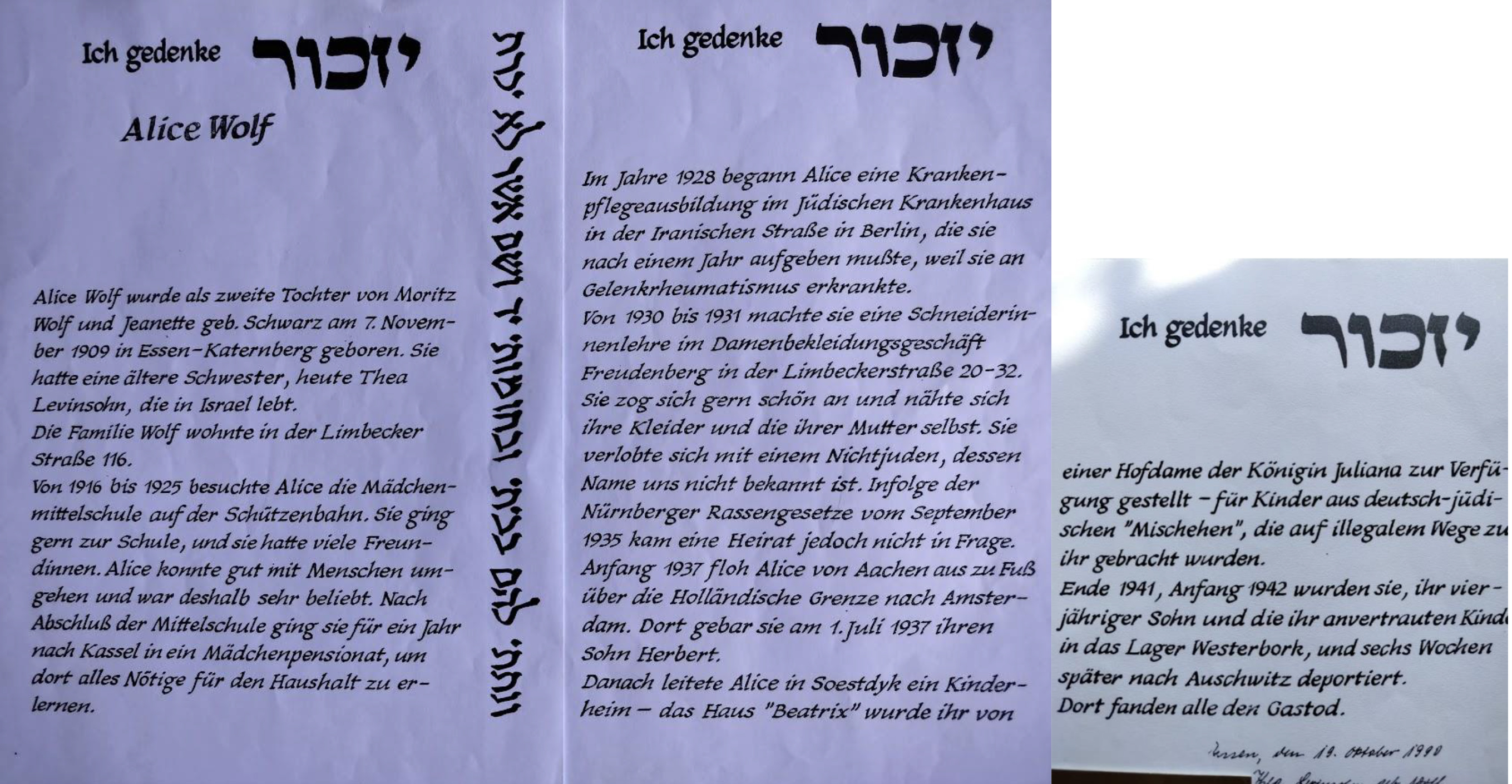
- A separate biographical account of Alice and Herbert Wolf has been compiled, partly based on the above text.
- At the beginning of 1940 the Wolf family consisted of approximately 60 people. As far as is known, only four survived World War II.